

If you want to know where the Denver Metro Area real estate market is headed, don’t look at prices. Look at behavior. November’s data shows buyers slowing down, sellers conceding more, and a widening gap between how homes are listed and how they actually close. That shift, more than any rate headline, is what defines this December market and the new year to come.
Last month’s numbers highlight a market that has become noticeably more selective. Sales volume dropped sharply, days on market climbed, and listing activity pulled back for the holidays. None of this is surprising, but the consistency of these trends is what matters. This isn’t a seasonal fluke; it’s a repeating trend, month after month, and the uncontested direction of our residential real estate environment.
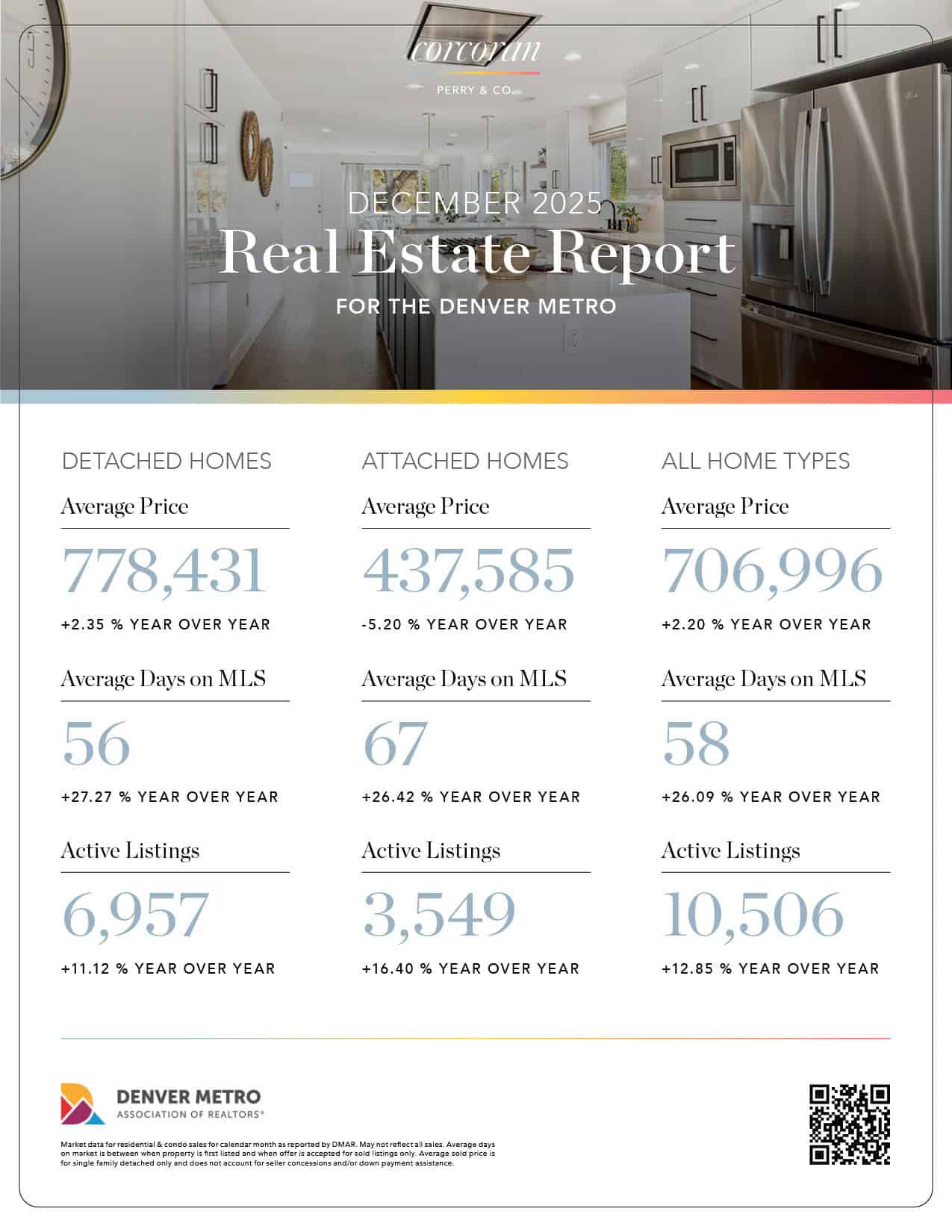
December 2025 Denver Metro Area Housing Market Report
Inventory Tightened for the Season, but Not the Trend
Active listings fell to 10,506, down 16% month-over-month, a typical late-year contraction. Even so, we’re sitting 13% above last year’s levels and well below the long-term November average of 13,416.
New listings came in at 2,620, a 41% monthly decline and a 4.6% yearly decline, reflecting highly selective seller activity rather than any meaningful supply shift.
Buyers Are Slowing Their Pace, Not Leaving the Market
Pending sales dropped to 2,923 (–11% MoM) and closed sales fell to 2,734 (–23% MoM, –13% YoY). Buyers are still active, but they’re not being rushed into decisions.
Average days on market rose to 58; median days climbed to 36. For buyers, these are the most favorable timelines in years.
The close-price-to-list-price ratio slipped to 98.25%, enough to indicate that negotiation has become part of the baseline again.
Prices Aren’t the Headline… Restraint Is
The Denver Metro Area’s average sale price landed at $706,996 (down 3% from October but up 2.2% YoY). Median prices held with minor softening.
Price stability isn’t telling the story this month. Market behavior is.
National data reinforces this: inventory has been rising for nearly two years, sellers are increasingly adjusting pricing, and according to the Federal Reserve, homeowners have more equity than at any point in recent history. Those factors prevent volatility but do nothing for affordability.
Local Signals Point to a Market Reorganizing Itself
Key Denver-area trends provide additional context:
-
Downtown activity back to 93% of pre-pandemic levels
-
Major employers opening new offices (Ibotta, FIRM GYM)
-
Job growth slowing to 0.6% YoY
-
A record number of new apartment units increasing rental competition
Rates Are Easing, but Not Enough to Reshape the Market
Mortgage rates near 6.23% are the lowest we’ve seen in years, but affordability remains constrained by wages, insurance premiums, and construction costs.
Rate stability will matter more in Q1 2026 than it did in Q4 2025… especially as new and re-launched listings hit the market in January.
What This December Market Tells Us About 2026
1. Buyer Leverage Will Continue Expanding in Early 2026
Not dramatically, but measurably. Longer days on market, softening list-to-close ratios, and widening negotiation margins all point to a first quarter where buyers aren’t under pressure to move quickly.
2. Sellers Will Need to Lead With Precision, Not Optimism
With more inventory returning in January and February, accurate pricing and strong presentation won’t just help. They’ll determine whether a home moves at all.
3. Affordability Will Remain the Defining Constraint
Lower rates help, but they don’t meaningfully offset higher insurance premiums, construction costs, or flat wage growth. If anything improves affordability in 2026, rates won’t do it alone.
4. Inventory Will Slowly Build, But Not Enough to Reset the Market
The Denver Metro Area remains structurally undersupplied, even with seasonal fluctuations. The “silver tsunami” demographic shift (boomers aging out of homeownership) may start contributing inventory, but the effect will be gradual rather than sweeping.
5. The Market Will Move With Intention, Not Momentum
The speed-driven dynamics of 2020–2022 are behind us. Much like this year, 2026 is shaping up to be defined by selective movement: fewer impulsive offers, more careful evaluations, and a widening gap between well-positioned listings and everything else.
In other words: 2026 won’t hinge on a single catalyst. It will hinge on accumulation of inventory, negotiation patterns, and sustained buyer patience.
 Corcoran Perry & Co. Featured Listing: 7912 Galileo Way, Ravenna, Littleton
More of the Same Change
The December Denver Metro Area housing market isn’t waiting for a turning point. It’s shifting through the steady choices buyers and sellers make each month: slower offers, longer listing periods, tighter negotiation, and pricing that reflects those decisions. The numbers don’t signal urgency or instability; they signal a market working without its old pressure valves. How 2026 unfolds will come down to how precisely participants respond to a landscape that now values accuracy over speed.
Ready to make your next move? Our Denver Real Estate Experts can be your guide.

Gina Cornelison




















Socials