

Restraint has governed the Denver area housing market for several years now. One thing’s for sure… Colorado knows how to hold ‘em and when to fold ‘em.
Buyers have largely remained employed, financially qualified, and broadly interested in owning homes, but many have chosen not to move unless the circumstances felt unavoidable.
And for good reason; higher mortgage rates have dramatically altered monthly payment burdens. So have rising insurance costs, persistent inflation, and a broader economic environment that make long-term financial commitments harder to uphold.
Still, the May 2026 Denver Area Housing Market Report hints that some buyers are ready to place a bet (or, at least, an anty). But not all buyers have the chips to stay in the game.
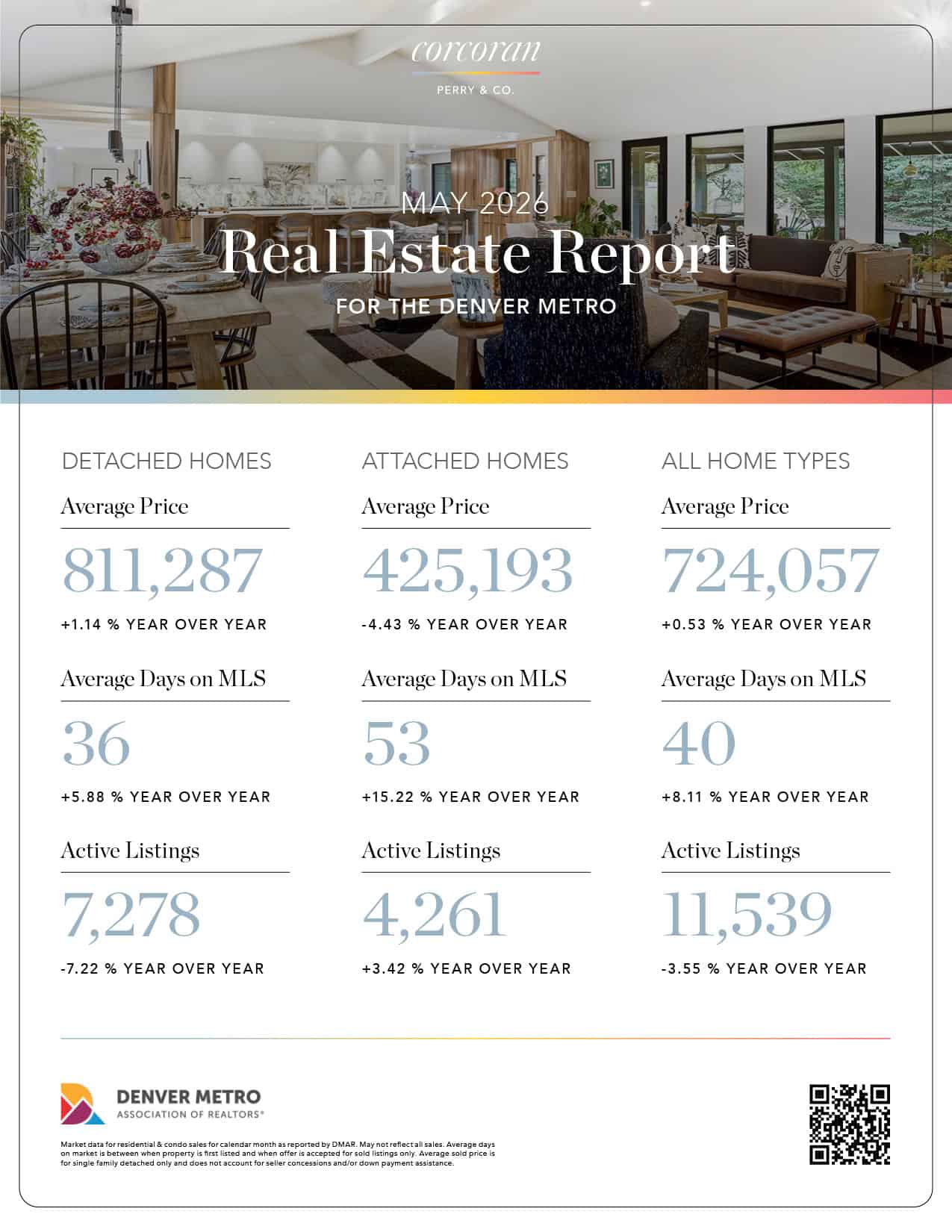
May ‘26 Denver Metro Housing Market Report
Residential Real Estate at 5280, By the Numbers
At first glance, home prices appear to be breaking through the stagnation of recent history because the median closing price is up 2.54% from March. However, the year-over-year (YoY) is only up 0.17%. For two years, Denver’s overall value has been slowly flatlining, hovering slightly above or below zero. With the YoY increase within that modest range, this value increase is likely the yearly spring boost, creating a small peak in the plateau.
That said, single-family homes are gaining sales momentum. The median price for detached homes hit $670,000, a significant 4.36% jump from March and 1.52% YoY. Moreover, they’re selling in just 11 days (Median Days in MLS).
The condo and townhome segment is in a documented decline. While detached home prices went up 4.36%, attached homes dropped 3.15% in a single month. Prices are down compared to last year (-0.53%), and sales volume is down 11.43% YoY. And these units are sitting for 26 days; more than double the time of a house, and a 18.18% increase since last year.
Pending sales reinforce this apparent attached vs. detached disparity with standalone homes up 10.93% YoY, while pending sales for condos and townhomes are down 7.31% YoY. This shows that demand is strong for single-family houses, but weak for attached homes.
One City, Two Markets
The ‘hold ‘em or fold ‘em’ mentality that defined the start of 2026 has transitioned into a calculated gamble. While the national market reacts to every decimal point shift in mortgage rates, Denver maintains its pragmatic participation.
The data confirms that the "wait-and-see" restraint is finally being overridden by the necessity of life… at least when it comes to standalone homes. This acceptance has created a distinct "Seller’s Island" for detached homes, where low inventory and high demand have kept the market moving at a lively 11-day pace.
A correlation can be seen in this statistical picture. Generally, attached homes are more affordable than detached homes, implying that socioeconomic status (SES) plays a large role in the ‘two cities’ narrative. Households living on smaller incomes (the ones most typically in the market for attached homes) still, intelligently, lean toward saving every fraction of an interest percentage point, while those with more financial wiggle room (the ones favoring detached homes) can absorb a higher mortgage rate.
Colorado. Not Your Average State.
The U.S. Housing Market
Across the U.S., April saw a significant release of pent-up demand. New pending sales reached their highest level since 2022 in late April. Media reports attribute this to a brief window where mortgage rates dipped, enticing buyers who had been sidelined for months.
Many states are seeing sellers finally returning to the market, too. Active listings are up roughly 4.6% YoY. In some regions, particularly the Northeast and Midwest, inventory levels are the healthiest they have been in four years. At the same time, national home price appreciation has slowed to a crawl, with annual appreciation hovering around 0.4% to 0.9% (with detached homes at about 0.5%). When taken in context with inflation, these equity ‘increases’ are actually net losses. This ‘listings up, prices not scenario is the outcome of eased scarcity: more homes means less competition… and less competition means no more inflated prices. (Just ask eBay.)
 Corcoran Perry & Co. Featured Listing: 4607 W Wagon Trail Road, Littleton, Bow Mar
The Denver Metro Area Housing Market
Unlike the national market (where single-family home values are barely budging with a 0.5% annual nudge), Denver’s detached houses are showing surprising muscle. While the broader Western U.S. has seen a 2.9% dip in house prices, Denver’s single-family homes climbed 1.52% year-over-year.
This statistical resilience suggests that many Denver buyers are willing (and financially able) to both accept higher interest rates and compete for stand-alone space. While the national condo market is actually seeing slight price growth, Denver’s condo segment is "folding," dragging down the city's total average and masking the fact that traditional houses are still a hot commodity. The high percentages of Denver millennials also play a role here. About 31% of Denver's population are millennials, compared to the U.S. average of approximately 22%. Young families (that is, middle-aged parents with small children) may be outgrowing their homes, compelling moves despite higher mortgage rates.
Ready to make your next move? Our Denver real estate experts can be your guide.

Gina Cornelison




















Socials