
Just a couple ofimportant things that you ought to know when thinking about buyinga 993 (or have just purchased one), especially if you've neverowned an air-cooled Porsche911 before.
"993" is the common nomenclature for 911s builtbetween 1995 and 1998. 993 was Porsche's in-houseproject codename. Similarly, 996 refers to 911s built between 1999and 2004. Porsches built before 1999 were air-cooled, meaning thereare no radiators or radiator fluid - those built after 1999 arewater-cooled, like most modern cars.
- It takes about a mile to warmup an air-cooled 993 the morning, also it often takes about thesame time for the brakes to be up to full pressure (so don'tworry when you see the brake light stay on for a couple ofminutes). But you don't need to worry, even when not at fullpressure the brakes work just fine.
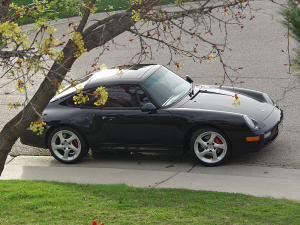 Note: You don't need to warm a993 up in the winter, just get in and drive you actually riskoverheating it if you try to warm a 993 up.
- The rear brakes sometimessqueak when they are dirty with brake dust. However, the stoppingability of any 911 will blow you away.
- Like any Porsche, a 993 likesto be driven over 3000 RPM, unlike the average car that you wouldnormally shift at 2500-3000RPM.
- You need to pay attention to 3oil gauges on a 993, and the most important one, the oil levelgauge, can only be read when you are stationary in idle. Also, thedipstick is useless because the gauge is more accurate. Typically,a 993 will consume about a half quart every month or so (assumingit's driven regularly).
 When adding oil to a993 only add a half quart at a time. Stick with whatever brand ofoil has historically been used in your car - I've heardchanging oils can cause the seals to shrink and thus oilleaks.Porsche recommends Mobil 1(SAE0-W40). Also, keep a quart in thetrunk for low oil emergencies.
- 993s that are not drivenregularly are more apt to have issues with engine leaks, due togasket drying and shrinkage,and valve clogging due to fuel sittingstationary.
- The correct tire pressures for993's and 996's are 36 Front and 44 Rear. Be warned, mosttire store technicians will tell you they should be at 40 psi bothfront and rear but this is incorrect per the manuals for both 911makes.
- The window switches only lastabout a year. The good news is they only cost about $35 to replace.When they begin to fail, the windows will stutter orstall.
- The batteries in the key remoteslast a little longer and are also inexpensive - $14. As the remotebatteries weaken, the distance you need to be close to the car tounlock the doors will shorten. With a strong battery, you'll beable to unlock the doors from 20 feet away or more.
 993s have 2buttons for AC, one is full blast out of the main vents only andthe other is auto temperature direction adjustable. The OEM Heat/ACControllers are known to fail. To replace a Control Head runs about$1,000. The best source for used Porsche parts that I have found isParts Planet at 1-800-783-4911.
- For more information and/ortechnical questions, it's imperative that you join the PorscheClub of America. For a $42 annual membership, you will benefitfrom a 10% service discount on labor at most Porsche dealers, aswell as expert online technical assistance. You'll also receive a monthlycopy of Panorama magazine.
- You've probably heardcorrectly that there is no cup holder or right armrest. This istrue, and the ignition is on the left side of the steering wheellike most Porsches.
- Why you should never lift offthe accelerator during a high-speedturn! "Driving a 993 at thelimit is all about smooth weight transfer. This is a hard conceptto grasp because 99% of your time driving you are well within thelimits of the car, so whatever incorrect driving technique you dodoes not have any bad effects. But when you are driving at thelimit of your car, you can easily spin it causing harm to yourselfand your car. If you are in a turn and you lift off the throttleabruptly you will transfer the weight to the front wheels and offthe rear wheels. Since most of the weight is in the back Porsche911, this is going o allow the heavy rear end to keep going in thedirection it was before you lifted (remember that high schoolphysics about an object in motion tends to stay in motion?). Theresult is you spinning. The rear end will keep moving because thereis not enough weight on the tires to provide the friction needed tokeep it in place because you transferred the weight to the fronttires. Only do an abrupt lift, and only do heavy braking, when youare going straight.
"Staying on the gasduring a turn is one of the hardest things to learn. It goesagainst every ounce of common sense. When you are going too fastinto a turn, the last thing you want to do is go faster. But youhave to fight that urge because you will spinotherwise.
- My last bit of advice is thatyou take your time getting to know your new Porsche 911 (993) -don't push the limits until you've spent at least sixmonths getting to know your car.
Please leave any tips for 993 owners I'veforgotten to mention below as acomment.
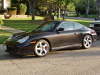 P.S. I sold this Porsche(1997 911 C4S) in July '09 with 89,000 miles on it for $39,000.At the same time, I purchased a CPO 2003 911 C4S (996) with 41,000miles for $39,000.
Written by Corcoran Perry &Co. CEO Jon Larrance.
Just a couple of important things that you ought to know especially if you've never owned an air-cooled Porsche 911 before. FYI: "993" is the common nomenclature for 911s built between 1995 and 1998.




















Socials