

Part Three.
When we first saw the house, the house was occupied by five smelly, dirty, hippie boys, so it was tough to see the potential. The rent was far below market value, it was difficult to wrap our brains around continuing the lease for another 16 months. The space was so cluttered, it was hard to see the walls and windows, let alone how much of a money pit it could be. Extreme "vision" was required! Unfortunately (or fortunately?) for you, though, we don't have any photos of the space while it was occupied by the tenants. To give you a good overview of the layout, we do have a video of a much cleaner version of the property, narrated by my lovely wife!
Determining what we'd like to do with the space required diligent scientific study and research and some exploration of creepy attics and mystery walls.
First, we made a list of priorities, even beyond what we created when looking to buy. We knew a true masonry fireplace, and extension/addition, or a pop-top was out of the question. However, we wanted at least three bedrooms, and open-concept floor plan and a master suite. Is that too much to ask?? To accomplish this, we first established minimum dimensions for each space by researching average sizes of furniture and adhering to minimum recommended clearances. For instance a recommended dimension for any bedroom is at least 9' x 9'. Using a scaled drawing and graph-paper-puzzle pieces to represent storage and furniture, we determined a layout of each mainfloor bedroom accommodated at least a single twin bed with plenty of closet space.
After establishing we could get two comfortable bedrooms and a bathroom on the main floor, we looked at the shape and size of the remaining square footage to eek-out an open concept floor plan. Kitchens in general are a bit trickier, but the National Kitchen+Bath Association website (www.nkba.org) has a lot of great information about landing space clearance, standard appliance dimensions, etc. It's a great resource! There are other free resources like Sketchup (see images below) that can help with quick 3D layouts to get a better sense of any space.
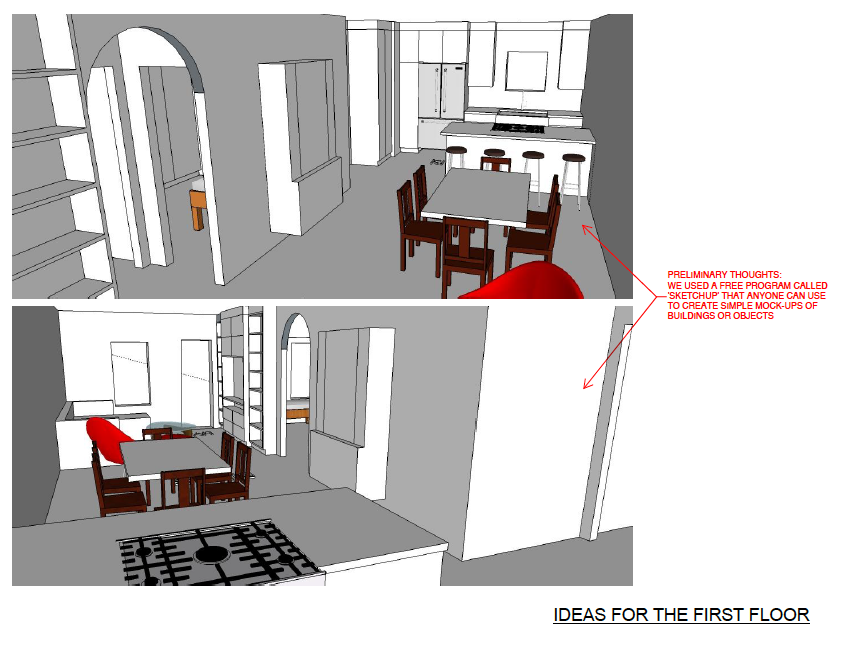
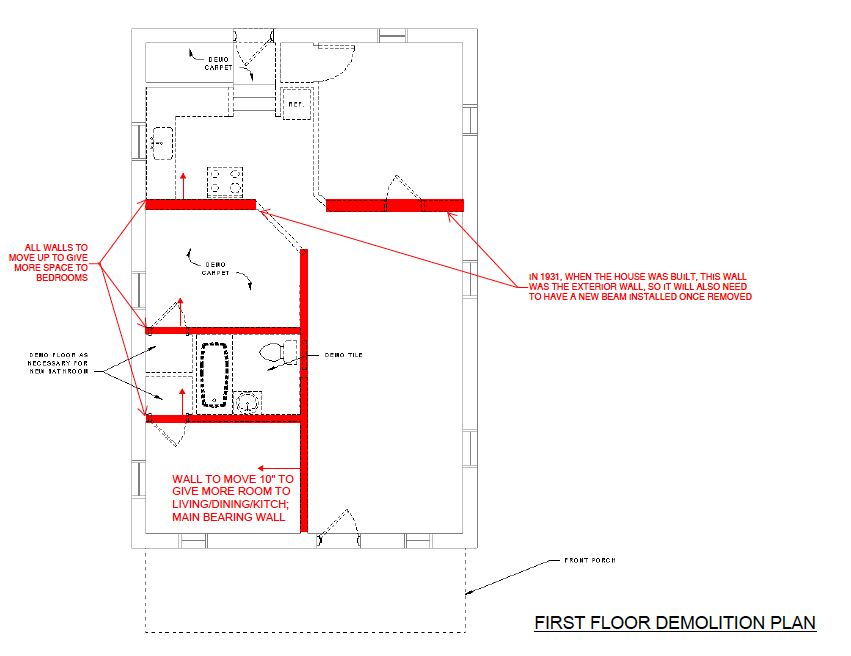
Although we had great ideas for the first floor, how could we know if what we wanted was possible? Worth the expense? The first step was to determine how many of the walls we could move or remove completely. (Note: If money were no object, all walls of kind are completely moveable. As with anything, however, there is a tipping point.) Is 3 inches of added clearance worth $10,000? Are 12 more inchesof head room worth $80,000? Rarely is the answer to these questions, "yes." We determined the concrete zone of death in the middle of the basement was not worth moving by punching several holes in the drywall concealing the area.
To determine if the first floor walls could be moved, we went on an exploratory expedition to the vermin-invested attic. There were several signs that the extra thick walls at the west end of the house were the original exterior walls. In most cases, houses of this era were very small with exterior root cellars and/or coal shoots. It's common for these spaces to have been incorporated via an addition. This addition is usually wood construction and siding, not meant to feel 'as one' with the mainhouse. Our house, however had a expertly executed (albeit still visible) seam where the addition was connected. When we got into the attic the gable end of the old roof was even still visible, confirming our suspicions.
The central wall that bi-sects the house was also a highly-probably candidate for a structural bearing wall. To confirm, we looked in the attic to see if the joists spanned continuously across the entire width of the house, or if they crisscrossed at the wall's top-plate (pictured below). Note: These are not the only ways to determine if a wall is structurally important. Nor do we mean to imply that, if none of these conditions are present, it can be assumed that none of the walls are load-bearing. You should always consult a licensed structural engineer before any wall removal is executed, even by an experienced contractor.
In the end we decided to leave the basement bearing walls and concrete alone, but focus most of our energy on the main floor.
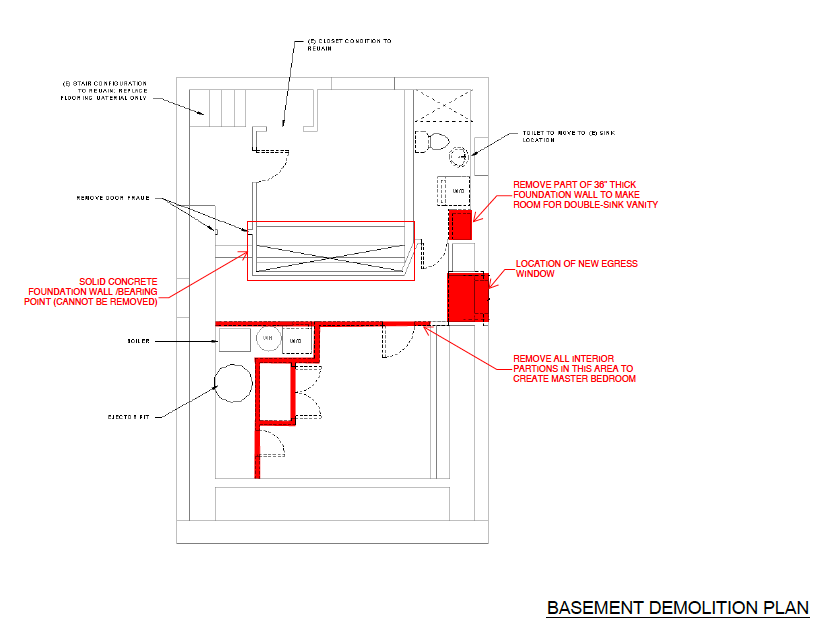
Last, but not least, we still have a budget to stick to. Was our vision within our reach? Apparently just five years ago we could have made all the changes we ever wanted to this house on a fraction of our current budget, but today that is a pipe dream.















Socials